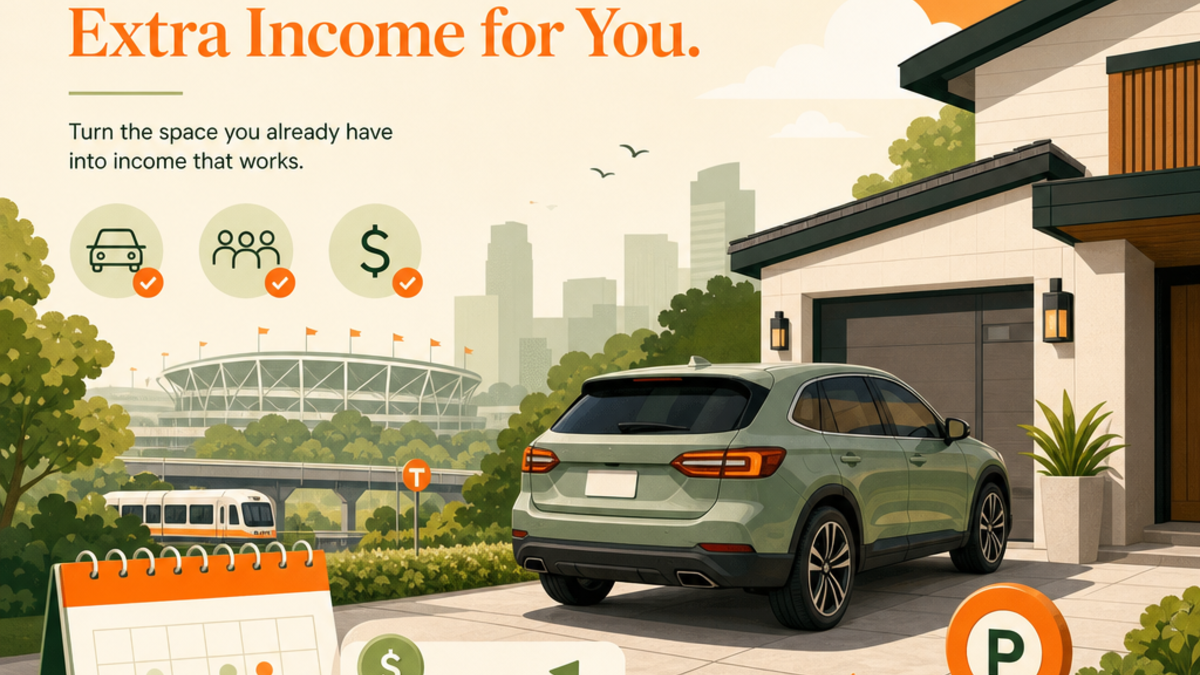
Driveway rental demand splits into two meaningfully different markets: short-term event or commuter parking, and longer-term vehicle storage. They're driven by different demand factors, priced completely differently, and a driveway well-suited to one may be poorly suited to the other. This guide covers both, so you can identify which market your specific driveway actually fits before you price it.
This assumes you already understand basic Neighbor host earnings. This is the driveway- and parking-specific version of that business.
Two Different Demand Patterns
Treating driveway rental as one undifferentiated category is the single biggest strategic mistake a host can make here, because the two use cases behave almost nothing alike.
Short-term/event parking. Demand driven by proximity to a specific venue, transit point, or destination -- a stadium, a downtown event, an airport, a transit hub. Renters need parking for a discrete event or trip, often just hours or a day, and they're willing to pay a real premium for genuine proximity to wherever they're actually going.
Long-term vehicle storage. Demand driven by general need for somewhere to keep a vehicle, RV, boat, or trailer -- unrelated to any specific event or destination. This is closer in character to general Neighbor storage economics, priced and occupied more like a garage or storage unit than like event parking.
Why the distinction matters so much. A driveway a few blocks from a stadium can command event-day rates that a driveway a mile away simply can't match, because event parking value is driven by very specific proximity, not general neighborhood desirability. That same driveway, without any event nearby, competes in the long-term storage market on completely different terms -- general convenience and price, not proximity to a specific destination. Your driveway's actual location determines which market you're really in, and possibly both, but you have to evaluate each on its own terms rather than assuming one pricing logic covers both.
How Pricing Works for Each Use Case
Event and short-term parking typically prices per-day or per-event, often at a real premium relative to what the same space would earn as long-term storage. A driveway that might rent for a modest monthly long-term storage rate can earn a meaningful fraction of that in a single event day, if the proximity and demand are genuinely there. This premium reflects genuine scarcity -- on a big event day, parking within real walking distance of the venue is a limited resource, and renters pay accordingly.
Long-term vehicle storage prices more like standard Neighbor storage -- a monthly rate based on local comparables, vehicle size if relevant, and general market conditions rather than event-driven scarcity. This follows the same pricing logic covered in the general Neighbor.com host earnings guide, just applied to outdoor vehicle space rather than indoor storage.
Don't apply one pricing logic to both. A host who prices their event-proximate driveway at a flat long-term-storage rate is leaving significant event-day premium on the table. A host who prices a driveway with no event proximity at an aspirational event-parking rate will simply sit empty, since there's no demand at that price without the proximity driving it.
Location Factors That Drive Value
For the event/short-term use case specifically, location isn't just important -- it's almost the entire value proposition.
Proximity to stadiums, arenas, and event venues. The closer, the higher the achievable rate on event days, and the effect is sharp rather than gradual -- walking distance commands a real premium over a short drive, which commands a premium over a longer drive requiring a shuttle or rideshare.
Proximity to transit hubs. Commuter parking near a train station or transit hub creates recurring, non-event-dependent demand -- a different but related use case with its own steady rather than spiky pattern.
Proximity to airports. Airport-adjacent parking taps into a large, recurring demand pool, often with longer individual rental durations (days, sometimes longer) than event parking.
Proximity to downtown or high-traffic destinations. General downtown proximity supports commuter and visitor parking demand even without a specific venue nearby.
The sharp proximity effect, specifically. This is the detail that separates a genuinely valuable event-adjacent driveway from one that merely feels close. Value drops off faster than intuition suggests as distance from the specific venue or destination increases -- a driveway two blocks away and one eight blocks away are not offering a similar product, even though both might reasonably be described as "near" the venue. Renters attending an event are optimizing for walking distance and ease, not general neighborhood proximity, so don't assume being in the same part of town as a venue is the same as being genuinely close to it.
For the long-term storage use case, location matters differently -- general neighborhood desirability, ease of access, and local comparable pricing, without the sharp proximity cliff that defines the event-parking market.
Practical Considerations Beyond Location
Surface condition. A well-maintained, solid surface matters for both use cases, but especially for longer-term vehicle storage where a vehicle sits in place for weeks or months rather than hours.
Accessibility. Can a renter easily get in and out? For event parking, ease and speed of access matter enormously given the short-duration, high-turnover nature of event-day use. For long-term storage, access needs are less time-pressured but still need to be clear and reliable.
Whether the space can be blocked in or requires flexible access. This is a real practical constraint many hosts overlook. If your driveway has one vehicle behind another, or shares access with your own household's vehicles, you need a system for coordinating around that -- covered further in the FAQ, since it's a genuinely common scheduling conflict for driveway hosts specifically, more than for garage or dedicated storage-space hosts.
Space dimensions. For long-term vehicle storage especially, confirm your driveway actually accommodates the vehicle sizes you intend to market to -- the same turning-radius and length considerations covered in RV storage hosting income apply if you're marketing to larger vehicles.
Local Parking Regulations and HOA Rules
This deserves real attention before you list, since some areas restrict this kind of use even on private property -- a constraint that catches new hosts off guard because it feels counterintuitive that your own driveway would be regulated.
Local parking ordinances. Some municipalities have rules affecting how driveway space can be used, including restrictions relevant to renting it out commercially. These vary significantly by location and aren't something to assume don't apply just because it's your own property.
HOA restrictions. Homeowners associations frequently have rules about driveway use, parking arrangements, or renting space to non-residents. Check your specific HOA's governing documents before listing, not after a violation notice arrives.
How to check. Review your local municipality's parking and zoning rules directly, and review your HOA's governing documents if applicable. When in doubt, a direct inquiry to the relevant local authority or HOA board is worth the time before committing to a listing, given that the consequences of an undisclosed violation can range from a fine to being forced to take the listing down after you've already built booking momentum.
Don't assume that because it's your private property, you have unrestricted freedom to rent it out commercially -- confirm this specifically for your location before listing.
Worked Example One: Event Parking Near a Venue
A driveway within genuine walking distance of a stadium or major event venue.
The demand pattern: spiky and event-driven -- near-zero demand on non-event days, strong demand concentrated on event days, with the highest-demand events (major games, popular concerts) commanding the strongest premium.
The pricing approach: per-event or per-day pricing, priced at a real premium reflecting the genuine walking-distance proximity. Rates on major event days can be priced meaningfully higher than a quiet weekday would ever justify, because the scarcity is real and specific to that day.
The realistic annual picture: income here is concentrated in a relatively small number of high-value event days rather than spread evenly across the year. A driveway near a venue with a busy events calendar (frequent games, concerts, or other draws) can generate meaningful income from a modest number of event days, but the host should model annual income around the venue's actual event frequency and typical attendance, not assume every week brings event-level demand.
The read: this driveway's value is almost entirely a function of its specific proximity and the venue's event calendar. A nearly identical driveway a short distance farther away, without the same walking-distance advantage, would see meaningfully weaker demand and should not be priced the same way.
Worked Example Two: Long-Term Storage in a Residential Area
A driveway in a general residential area with no special event or transit proximity.
The demand pattern: steadier, driven by general vehicle storage need rather than any specific event calendar -- someone needing somewhere to keep a car, a small trailer, or occasional overflow vehicle storage.
The pricing approach: monthly rate based on local comparable storage listings, following standard Neighbor storage pricing logic rather than event-parking logic. The storage space pricing calculator applies directly here.
The realistic annual picture: more predictable than the event-parking scenario -- steady monthly income at a moderate rate, without the spiky, concentrated pattern of event-day premiums, but also without the outsized single-day earning potential a well-located event driveway offers.
The read: this driveway's economics resemble standard storage hosting far more than they resemble event parking, because there's no proximity-driven scarcity to price around. This is a legitimate, steady income source, just a fundamentally different one than the stadium-adjacent example above.
Decision Table: Matching Location to Use Case
Walking distance to a stadium/venue. Event parking. Per-day/per-event, premium on event days Near a transit hub or train station. Commuter parking. Per-day or recurring, steadier than pure event parking Near an airport. Short/medium-term parking. Per-day, often longer average duration General residential, no special proximity. Long-term vehicle storage. Monthly rate, standard storage comparables Near downtown/high-traffic area, no specific venue. Mixed -- test both. Start with storage pricing, test event/commuter demand if signals emerge
Use this as a starting hypothesis, then validate against actual local comparable listings and their apparent activity before committing to a pricing strategy.
Common Mistakes
Pricing a driveway the same for both use cases without recognizing they're different markets. The central mistake this article addresses. Event-proximate driveways underpriced at flat storage rates leave real premium on the table; driveways with no event proximity priced aspirationally at event rates simply sit empty.
Not checking local parking or HOA restrictions before listing. Assuming private property means unrestricted freedom to rent it out commercially, when local ordinances or HOA rules may restrict exactly this use. Check before listing, not after a complaint or violation notice.
Underestimating how sharply proximity value drops off. Assuming "close to the venue" is a single category, when a two-block driveway and an eight-block driveway are genuinely different products for event-day renters optimizing for walking distance. Price and market based on your actual, specific proximity, not a general sense of being nearby.
Ignoring scheduling conflicts with household use. Listing a driveway that's also needed for the host's own vehicles without a clear system for managing the overlap, leading to conflicts and cancellations that damage your host reputation.
Not validating which market your driveway actually fits. Assuming event-parking demand exists without checking a venue's actual event frequency and nearby comparable listings' apparent activity, or assuming storage demand exists without the same local validation.
When a Driveway Isn't Worth Listing
Be honest about the disqualifying case: a driveway with no meaningful proximity advantage for event parking and no clear long-term storage demand either may not be worth listing at all.
If your driveway is too far from any venue or transit point to command real event-parking premiums, and your area doesn't show strong signals of general vehicle storage demand (check comparable listings for occupancy and pricing, the same validation approach covered in self storage host diversification strategy), the achievable rate in either market may not justify the access coordination and scheduling overhead involved. A driveway earning a marginal amount, while requiring you to manage access requests and potential household-use conflicts, may simply not be worth the operational friction relative to the modest return.
Validate demand honestly before listing: check nearby event venues and their calendars for the short-term case, and check comparable long-term storage listings' pricing and apparent occupancy for the storage case. If neither shows real signal, that's useful information -- not every driveway is a good candidate for this business line, and that's fine.
Frequently Asked Questions
How do I handle scheduling conflicts if I also use the driveway myself?
This is a real, common issue for driveway hosts specifically, more than for dedicated storage space. Set clear availability windows in your listing that account for your own household's needs, and be conservative about what you mark available rather than overcommitting and creating conflicts. For event parking specifically, block out dates you know you'll need the space yourself well in advance, since event-day demand books ahead.
Do local parking regulations typically restrict this kind of listing, and how do I check?
It varies significantly by location -- some areas have no relevant restrictions, others regulate driveway use for commercial purposes more than you'd expect for private property. Check your local municipality's parking and zoning rules directly, and separately check your HOA's governing documents if you have one. Don't assume; confirm for your specific location before listing, since violations can range from a fine to being forced to remove the listing.
Can the same driveway serve both event parking and long-term storage?
Sometimes, if you're willing to manage both markets -- using it for long-term storage most of the time and carving out event-day availability for premium short-term parking around major events near you. This requires more active management (clearing the long-term renter's vehicle or coordinating around them for event days) and works best when the long-term arrangement is flexible enough to accommodate occasional event-day exceptions, agreed upfront with the storage renter.
How much more can I really charge for event-day parking versus a normal day?
Substantially more on high-demand event days, reflecting real, temporary scarcity of walking-distance parking. The exact premium depends heavily on the specific event's draw and how close your driveway genuinely is -- check what comparable event-proximate listings actually charge and appear to earn on similar event days in your area rather than guessing at a multiplier.
Is long-term vehicle storage or event parking more reliable income?
Long-term storage is generally steadier and more predictable, similar to standard storage hosting. Event parking is spikier -- concentrated value on specific high-demand days, little to nothing in between, unless you're also picking up steady commuter or transit-adjacent demand. Which is "better" depends on your risk tolerance and whether steady modest income or concentrated high-value days better suits your goals.
Should I use the garage storage rental income calculator or the general pricing calculator for a driveway?
For long-term vehicle storage specifically, the storage space pricing calculator applies well, following standard storage economics. Event and short-term parking follows a different logic entirely, driven by proximity-based scarcity rather than standard occupancy-and-rate modeling, so treat that pricing decision as its own research exercise based on comparable event-parking listings rather than a general storage calculator.
What surface or setup improvements are worth making for a driveway listing?
For long-term vehicle storage, a well-maintained, solid surface matters more given vehicles sitting in place for extended periods. For event parking, ease and speed of access matters more than surface perfection, given the short-duration, high-turnover nature of event-day use. Match any investment to which use case you're actually targeting rather than improving generically.
The Takeaway
A driveway rental income guide has to start by recognizing there are two genuinely different markets here -- event and short-term parking, driven by sharp, specific proximity to a venue or transit point, and long-term vehicle storage, driven by general demand and priced like standard storage. Identify which market your specific driveway actually fits (or whether it fits neither well enough to justify listing), price accordingly rather than applying one logic to both, and confirm local parking and HOA rules before you list, since restrictions on this specific use are more common than hosts expect for what feels like straightforwardly private property.