Whether climate control pays for itself on a Neighbor listing depends on three things: how severe your local climate actually is, what renters in your area are searching to store, and whether you're building it in or retrofitting it later. A blanket "yes, it adds value" is misleading -- in a mild market with no demand for it, climate control is a cost with no return. This article gives you the real cost breakdown, the payback logic, and the demand-validation step most guides skip, so you can run your own numbers rather than guess.
|||
This assumes you understand basic Neighbor economics from the Neighbor.com host earnings guide and want to work through this one investment decision. Every cost and premium figure here is a general pattern -- equipment, utilities, and achievable pricing vary significantly by region and must be validated locally.
|||
What Drives Demand for Climate-Controlled Storage
|||
Climate control -- maintaining a stable temperature and humidity range rather than letting the space track outdoor conditions -- only commands a premium when renters have something that needs it. So the first question isn't "should I add it," it's "does anyone here need it."
|||
The items that actually drive climate-controlled demand:
|||
Electronics. Sensitive to heat and humidity extremes. Renters storing equipment, servers, or media often specifically seek climate control.
|||
Documents and photographs. Paper degrades in humidity. Business records, archives, and personal collections are common drivers.
|||
Wine. Needs both stable temperature and humidity, and wine storage renters pay a real premium where that demand exists.
|||
Furniture, especially wood and upholstery. Wood warps and cracks with humidity swings; upholstery grows mildew. Higher-value furniture is a frequent driver.
|||
Certain vehicles and specialty items. Collector vehicles, musical instruments, art -- lower-frequency but high-value when present.
|||
The pattern: climate-controlled demand tracks what people in your area own and need to store, which correlates with local affluence, housing type, and industry. A market storing mostly seasonal gear and boxes has thin climate demand; one storing electronics, documents, and quality furniture has real demand. Validate which yours is before spending -- the how is below.
|||
How Climate Control Affects Pricing and Occupancy
|||
Where demand exists, climate control affects both levers of income.
|||
Pricing. Climate-controlled space commands a premium over comparable non-controlled space in the same market -- often a substantial one where demand is genuine. That premium is the entire return you're buying.
|||
Occupancy. Less obvious and often more valuable: climate-controlled space can also occupy more consistently, because the renters who need it tend to store longer-term (archives, collections, furniture in a long transition) and are less price-sensitive once they've found suitable space. Longer average tenancy plus lower churn is a real, underappreciated part of the return.
|||
But both depend entirely on demand. In a market with no climate demand, you get neither -- no premium and no occupancy benefit, just a higher cost base. This is why demand validation is the whole game, not equipment selection.
|||
The Real Cost Breakdown
|||
Three cost buckets, and hosts routinely forget the third.
|||
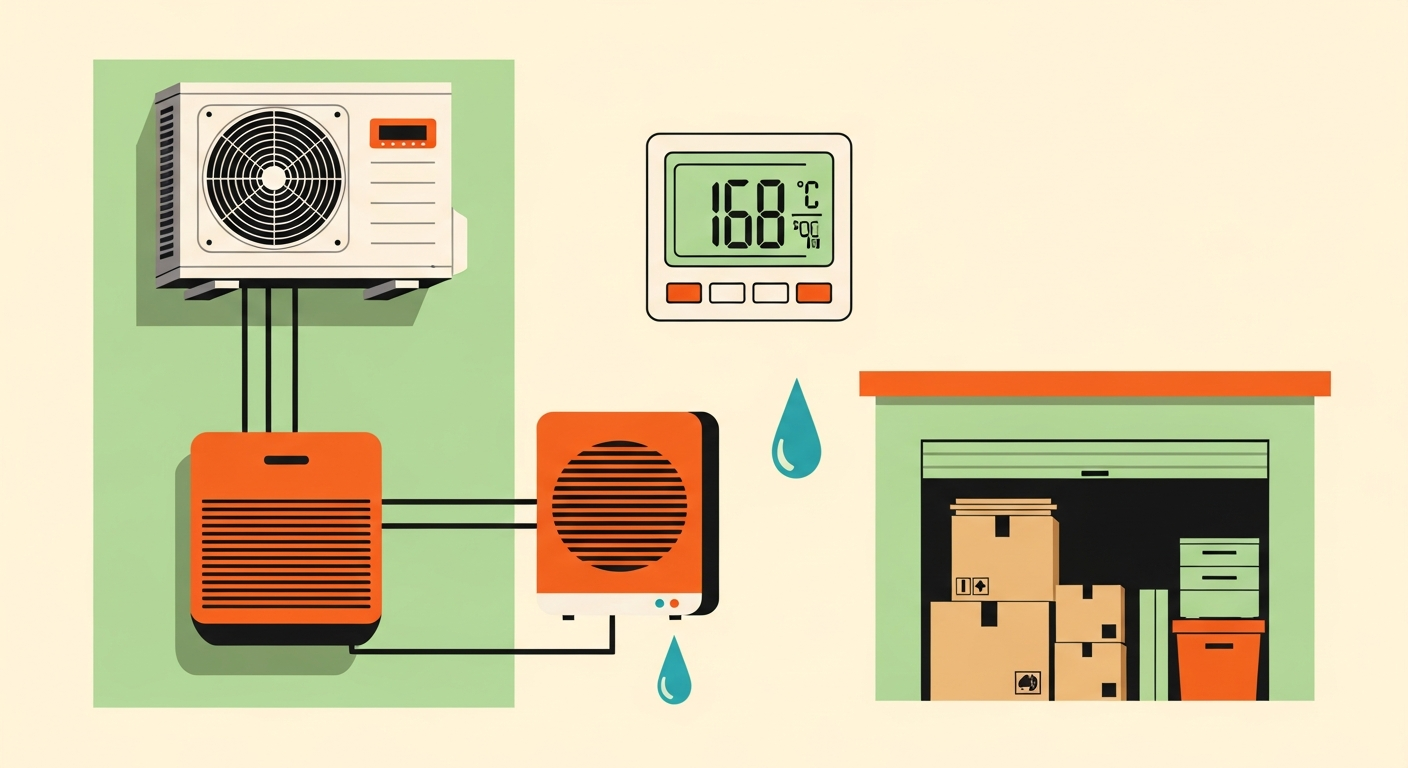
Equipment. For a modest space, a dehumidifier plus a heating/cooling unit (often a mini-split -- a compact, efficient system that heats and cools without ductwork) is the common setup. Larger or more demanding spaces cost more.
|||
Installation. A plug-in dehumidifier installs itself. A mini-split usually needs professional installation, which can rival or exceed the equipment cost. Insulation work, if the space isn't already sealed, adds meaningfully.
|||
Ongoing utility cost. The one hosts underestimate. Climate control runs continuously, and the electricity is a permanent monthly cost against your premium, not a one-time expense. In a climate with real extremes, this can be substantial -- exactly the climates where the premium is highest, which partly offsets it.
|||
| Factor | Non-Climate-Controlled | Climate-Controlled |
|---|---|---|
| Upfront equipment | Minimal | Moderate to high (dehumidifier + mini-split, possible insulation) |
| Installation | None to minimal | Low (plug-in) to significant (mini-split + insulation) |
| Ongoing utility | Negligible | Real monthly cost, scales with climate severity |
| Achievable price | Base market rate | Premium where demand exists; base rate where it doesn't |
| Occupancy pattern | Standard churn | Potentially longer tenancy, lower churn (demand-dependent)
|||
Run your own numbers through the storage space pricing calculator with and without the premium, and net the ongoing utility cost against the premium -- the gross premium always flatters the decision until you subtract the running cost.
|||
How Local Climate Severity Changes the Math
|||
This is the single biggest swing factor, and it cuts both ways.
|||
Mild climate. Where outdoor conditions rarely threaten stored items, the value proposition is weak -- renters don't need protection from conditions that barely occur. Premium is low, demand is thin, and your ongoing utility cost is also low (you're rarely running the system hard), but low cost against near-zero premium still nets out poorly.
|||
Severe climate. Extreme summer heat, hard winter cold, or high humidity create genuine need. Items are genuinely at risk in an uncontrolled space, so renters actively seek and pay for climate control. Premium is high and demand is real -- but ongoing utility cost is also high, since you're running the system hard exactly when it matters. The premium generally outweighs the cost where demand is strong, but you must model both, not just the premium.
|||
The counterintuitive part: severe climates have both the highest premium and the highest running cost. The decision isn't "severe climate = worth it." It's whether the premium net of the elevated running cost clears your equipment payback in a reasonable window.
|||
Worked Example One: Mild Climate, Modest Demand
|||
A garage bay in a temperate coastal market. Mild year-round, few extremes.
|||
Demand check: comparable listings show little climate-controlled inventory, and what exists isn't priced much above standard space. That's your answer forming already -- thin demand.